
What the seed guarantees
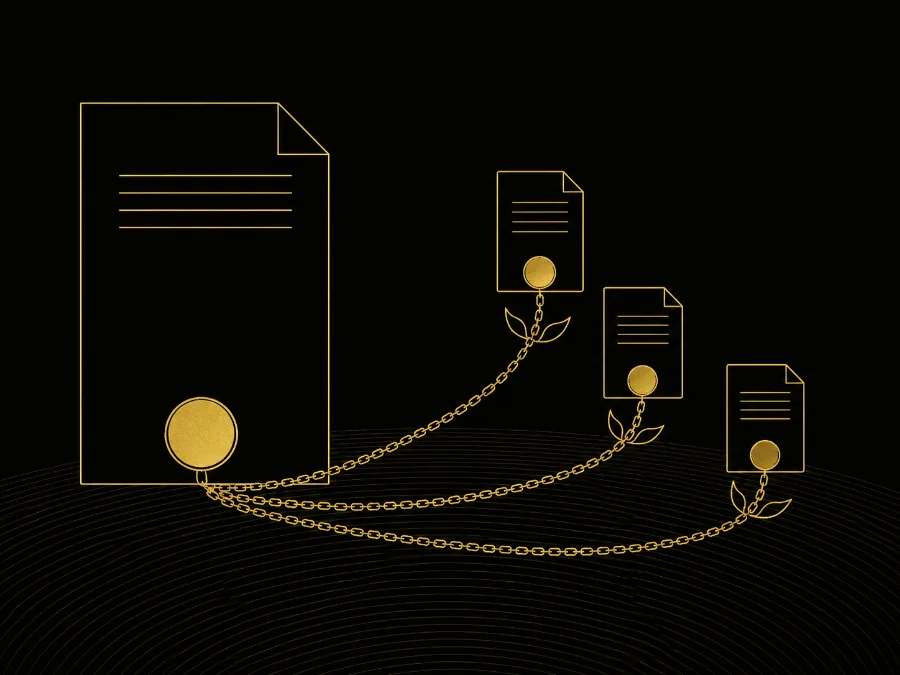
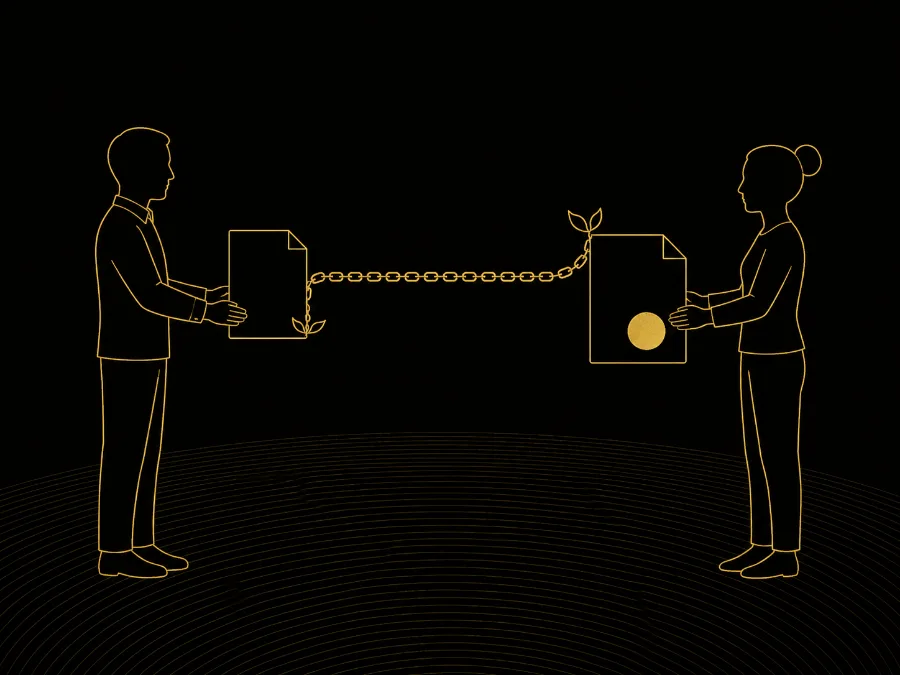
An open X-DOC hands nobody the pen to your document: it hands over a sealed copy, and the other person opens a chain of their own from there. The seal is a SHA-256 hash — a 256-bit fingerprint of the content, computed on the device of whoever records it. Under that same hash travels the seed: line, which names the originating link: that is what makes the lineage provable offline, without depending on us and without depending on the sender’s vault.
Recomputing the hash of the copy you received and comparing it with the seal proves not one comma changed along the way.
The seed: line goes under the hash and names the originating link. Your chain reads on its own, without the vault of whoever sowed it.
The link that arrived still belongs to whoever recorded it. Whatever you write is born under your seal — no book claims someone wrote what they did not write.
The sower’s chain does not stop and yours does not wait. Neither of them locks the other, and neither needs a referee to decide whose turn it is.
And what the seed does not guarantee: agreement. An open chain is recorded work, with authorship and an hour — it is not consensus. What binds the two parties is a signature over a hash, through the medal gate. Collaboration never collects a signature.
What the recipient can and cannot do
The rule is simple to state and holds forever: nobody writes in anybody else’s book. The recipient gains no permission over the other person’s document — they gain a certified copy of it and a book of their own to continue in. It is the difference between handing over the key to my book and handing over a certified copy of it.
- Read the whole content, offline, without asking anyone for anything.
- Plant the copy in their own vault and write freely on top of it — prose, not a form.
- Record as many versions as they like in the new chain: the numbering is theirs, and the seed occupies the first link.
- Sow it onward — send their version to whoever they like, including back to whoever started it.
- Change the link that arrived. It is sealed; the editing happens in the next link, in their own book.
- Make the sower’s chain move. That end stays on the device of whoever recorded it.
- Erase the lineage. The seed: goes under the hash: lose the hash and you lose the document.
- Stop the sower from carrying on. They go on in their own book while you write in yours.
 Bobauthor of the seed
V1
V2
V3
V4
V5
V6
∞
Bobauthor of the seed
V1
V2
V3
V4
V5
V6
∞
 Alicereceives from V3
V3
V1
V2
V3
V4
∞
Alicereceives from V3
V3
V1
V2
V3
V4
∞
 Jackreceives from V2
V2
V1
V2
∞
Jackreceives from V2
V2
V1
V2
∞
Tamper-proof versions
Every X-DOC propagation runs on a SHA-256 hash chain: each version carries, under its own seal, the hash of the previous version, and each seed carries the hash of the link that originated it. That is why a document can pass through as many hands as it likes without anyone being able to rewrite what already passed — and without the proof depending on us.
Change one comma in V2 and its hash changes — and that breaks the prev of V3, of V4 and of every version after. There is no silent edit: either the whole chain verifies, or it points at exactly where it stopped verifying.
Where the copy came from is not a label you swap later: the seed: enters the computation of the seal. Anyone claiming a false origin produces a hash that does not add up, and the hash adds up in nobody’s hands.
SHA-256 is a public standard. Anyone recomputes the seal with any tool, offline, with no wallet and no account — and reaches the same result or finds out the content changed.
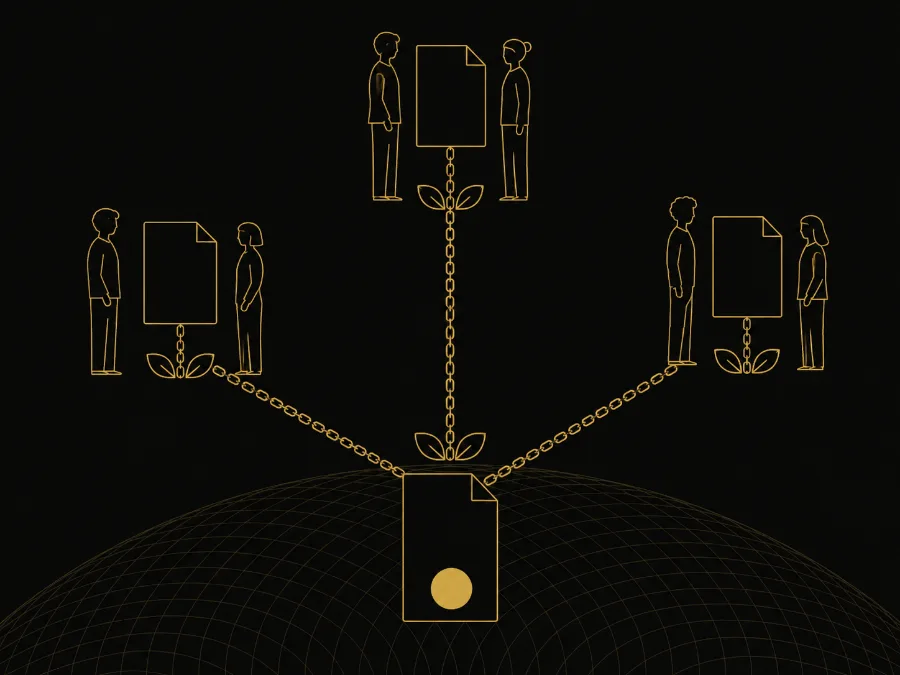
Because each chain grows on a single device, there are never two candidates for the same prev. That is why a fork here is not a risk to contain: it is the mechanism, and the only link that has to be forgery-proof is the one tying one book to another.
And where the chain does not reach: it only runs backwards. From any version the path to the origin is provable, but nobody enumerates the descendants — whoever sowed a document does not find out how many books were born from it, only the ones someone tells them about.
The proof also depends on having the links in hand. If Alice never shows her book, Jack proves his seed came from a certain hash, but not that the hash belongs to Bob’s document — for that he has her word. It is a chain of signed attestations: forgery is not prevented in the moment, it is detectable afterwards, when the original link shows up. That is how cross-referenced entries have always worked in a registry office, and it is why each link is signed by whoever recorded it.
What the mathematics settles on its own, what still needs an anchor and what the X-DOC does not replace are in the chapter Trust leaves the counter and moves to mathematics.
How to sow one
Sowing is an act of sending, not of recording: nothing is recorded in your book when you send. That is why the document has to be registered first — and recording is always sealed, because the seal is a property of the content, not an intention of the sender.
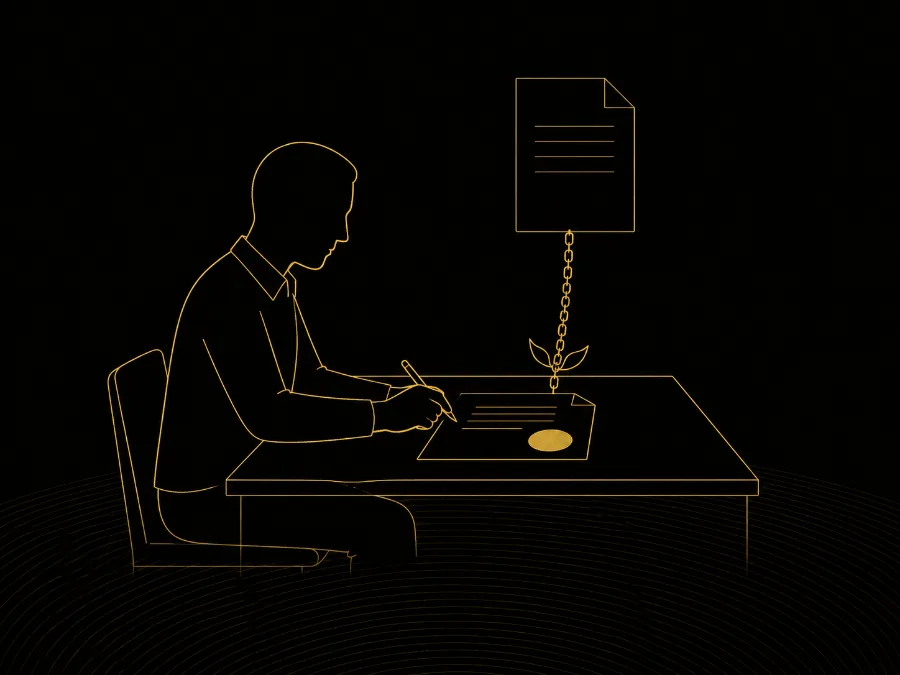
Register the document. Write it on your sheet and seal it. Recording is always sealed — the operation is chosen when you send, not when you record.
In the conversation, tap the + and choose Open X-DOC. It is the middle one of the three gates; the top one asks only for reading, the bottom one asks for a signature.
Choose the version that becomes the seed. The chain screen opens with every link: any registered version will do — the first, the last or one in the middle.
Send it. The sealed copy travels attached to the memo. Nothing is recorded in your book: sowing does not make your chain move, and you carry on writing in it as before.
When to use it
The question that decides is not the type of document — it is what you expect back. If you expect text, it is open. If you expect only acknowledgement, it is sealed. If you expect commitment, it is signature.
Do not use open to collect a signature. Open mode is collaborative and never implies commitment — the sheet of an open chain offers no "Sign". Whoever wants a signature records a sealed document and sends it through the medal gate.
Where an open X-DOC lands
It arrives on the tape, like every memo, and leaves it once you decide something. After that it lives in the Open X-DOCs box — one of the wallet’s three boxes, one per operation.
Inside the box, each document shows who sowed it — picture, name and address — because a chain born from someone else has to say where it came from. And that is where the editing carries on: the chain screen ends in a tip with a pencil, and tapping it opens the next version. There is no second route to edit; two gates for the same decision always diverge.
The blinking red light means something is owed, and it goes out when you open the seed and read it to the end. There is no acknowledgement and no signature: an open X-DOC asks nobody for a receipt — whoever sends a template is not charging for anything. The discharge is your own convenience, it stays on the device and does not travel. And editing remains an invitation: the tip with the pencil is there when, and if, you want it.